Thirty years ago, I was a kindergartener fascinated by art and computer games. Today, I’m Mom of two who has experienced and built many things, yet is remarkably unchanged. This blog post — which shares its title with the blog as a whole — tells my story.
I’ve had in mind to write this post for a long time. A few months ago, I was invited to give a talk of a similar nature to an all-girls robotics team this February. For reasons outside my control, I wasn’t able to attend, so this post serves in place of that talk (and expands on it a bit — the talk was going to focus on a subset of this content). Their invitation prompted me to thoroughly compile my experiences, and think about what kind of support and encouragement would have served me well 20 years ago.
This post shares the life of an artist and programmer through five seasons: elementary school, high school, college, museum tech career, and parenting young children/homemaking. At any given moment, I could not imagine how these seasons connected. My hope is that this post encourages readers to keep following their north star, remaining patient, diligent, and curious amidst challenges and uncertainty.
Season 1: Elementary School
Elementary school is where I discovered my love of the arts, technology, and gaming.
As a young elementary school-aged child, I loved playing computer games on my family’s computer. My interest in all things digital was established through these early experiences. There was much satisfaction in hearing the computer boot up and loading a CD-ROM disk. My favorite games to play were The Logical Journey of the Zoombinis and Where in the World is Carmen Sandiego? I also enjoyed Grolier’s The Electronic Encyclopedia. I loved going through various animal sounds as well as musical instruments — the zither is one, in particular, I hadn’t seen in real life but knew from the disk.
I also loved visually-based logic activities like Tangrams, as well as drawing and painting. One of my favorite memories growing up was attending a class at the local natural history museum where we explored the galleries and created sketches of taxodermy. I would frequently draw my cat at home, too.
The rise of various Nintendo franchises — Pokémon, Super Mario, and Legend of Zelda being my favorites — was a notable part of my childhood. I played video games often all through elementary school on GameBoys and an N64. My strong interest inspired me to design my own video game levels (visuals, logic, and music), bringing together many of my interests.
Season 2: High School
High school is where I sought mastery of STEM subjects and had many opportunities in the visual and performing arts.
When I attended high school at the Cambridge Rindge and Latin School, my world greatly expanded. It was an amazing experience which gave me so many opportunities at a young age.
I took dance, studio art, and photography classes. I was also part of the school’s Modern Dance Company where I was a student choreographer — this involved not just composing the dances themselves, but choosing costumes, music, and lighting. Every second of the music track was carefully mapped out on stage. There was quite a lot of planning involved, and I later found myself referencing this when programming animations later in my career.
My interest in math and science also solidified. I took many classes, and was involved in the Science Bowl and National Chemistry Olympiad. Off campus, I had the opportunity to take courses at Harvard as well as an environmental science expedition in Utah’s Red Butte Canyon with EarthWatch.
My senior year of high school, I had to make the decision if I was going to apply to art school or a technical school. I decided on a technical school. My sights were set on MIT, where I had attended free classes for high school students at their Splash program. I loved the atmosphere of MIT’s campus. One of my Science Bowl classmates had moved on to MIT and I also had a great uncle (a submarine engineer) I admired who attended there.
Season 3: College
The college season broke and rebuilt my self-confidence. I found myself on a much less traveled path to a career in tech.
Section 1: Scared Off by Computer Science
I entered MIT feeling very confident in myself, and quickly made many friends with a variety of interests. However, in this setting I found myself feeling lost and inadequate.
Within days of arriving on campus as a freshman, I became aware that a large number of my peers were planning on majoring in EECS (electrical engineering and computer science). I had heard this was a popular major before, and being on campus put it on my radar even further. Many students were signing up for UROPs (paid internships within various research groups) where they were using coding skills for a variety of things. Many of these groups were not even computer science labs, but other areas such as life sciences or urban studies. Many of these students had previous coding experience from high school, which I did not have. I continued to be interested, even signing up for the EECS mailing list, but psyched myself out of before I even gave anything a chance. I didn’t know how to get started.
Two years later, I did enroll in the introductory computer science class (I was required to take elective math and science classes, and given my previous interest, it seemed like a good idea). However, again, I found myself feeling quickly out of place and in over my head. Within the first week or two, I went to office hours for help, and was not able to understand the teaching assistant’s explanations of answers to my questions — this being the most basic of the computer science classes, I felt humiliated. I later changed to a different teaching assistant, who I found easier to understand, but nonetheless the course remained bumpy road for me.
Section 2: Finding Home in the Arts
As a freshman, I took many math and science classes as part of the MIT undergraduate core curriculum. However, I did not feel as enthusiastic as I did about STEM as I did in high school. Part of it was I was missing all of the project-based, creative activities I was immersed in in high school.
I found a home in the many arts programs at MIT. MIT has many visiting artists, events, classes, as well as a robust public art collection. As an undergrad, I had several part-time jobs including a role coordinating exhibitions for the Wiesner Student Art Gallery. The MIT Architecture Department (where I went on to complete my degree) also includes which the Media Lab, where later I would return as an exhibit software developer to attend the Connected Learning Summit and to attend filming for an exhibition.
MIT’s Undergraduate Research Opportunities Program (UROP) provided exhibit-related opportunities, which were the bridge to the next chapter of my life. I worked with two artists I deeply admired who gave me a lot of practical experience and inspiration. One project The Explorers Club highlighted human experiences through participatory art, building a photography series by engaging with and learning from a young boy with autism. I also assisted for two summers on a large-scale outdoor exhibition called The Expanded Field at MASS MoCA (Massachusetts Museum of Contemporary Art) in the Berkshire Mountains of Western Massachusetts — in this beautiful town, I gained a great deal of experience sketching, building, and collaborating with American artists and Swedish architecture students.
As an undergraduate, these incredible opportunities with the arts and museums eclipsed the negative experiences I had with computer science. I also felt like I found a rarely traveled, more interesting path that was better suited to me. It was like forging my way through a forest to create an entirely new path, instead of following the most common road.
Section 3: A New Pathway into Coding
My senior year at MIT, I became motivated to try coding again. I wanted learn to create a portfolio website to share my various art and design work. I also thought that, even if I decided to do something different later, having website development skills would remain a useful skill (I was right).
I took web design and development courses not at MIT, but at Massachusetts College of Art (MassArt) in their continuing education program. Yes, I literally took the train from MIT to take coding at an art school!
Around the same time, I reflected and realized that although I loved contemporary art museums, I wanted to explore something new. I was curious to see what it would be like to work in the science museum context. I looked into, and was fortunate to have, an internship at the Museum of Science, Boston.
I worked for a month as an intern at the Museum during the January break between semesters. I was introduced to some old websites they were thinking of reevaluating. I went through their pages, looked at their website traffic, and came up with some ideas for how to redesign them. This wasn’t very much time but it had a positive impact on my last few months before graduation.
All this time, I was working on my undergraduate thesis project, which explored visual patterns and storytelling in urban landscape architecture. A breakthrough moment for me was making my presentation an interactive online experience instead of a printed poster. I made a website and clicked through it (via projection) to present to my thesis panel rather than doing a traditional poster session. The ease (and fun!) of this format made me realize how much potential was in digital media to build things and very quickly and easily share with the world in an instant.
Season 4: Museum Tech Career
I spent a decade working on technology in the museum context (web and game development). During this time, I was both a mentor and mentee in the women in tech community. Things came full circle with the opportunity to work on exhibit focused on introducing engineering and computer science in a fun, user-friendly way.
Section 1: Web Development
I was feeling very excited and confident upon graduating from MIT. I pulled so many of my interests together with my custom-built online thesis presentation, and I was excited to return to my internship that summer. Some of my peers were heading to graduate school or more “permanent” jobs. I had just my internship without anything planned beyond that.
I learned a lot that summer, mainly working with web development basics (HTML and CSS) and graphic design tools (Adobe Creative Suite). I met people from many departments and learned about the work they did. One group I worked on a small web app for was the former Cahners Computer Place exhibit. I created web pages featuring the different components of the exhibit, so I had a chance to learn about the exhibit itself in the process of creating something — learning content while building its technology would be something I’d enjoy for years to come.
I would go on to start a full-time web developer role at the MoS, where I had the opportunity to work with a variety of internal stakeholders, especially for marketing efforts. This was incredibly valuable because I learned a lot about copywriting and the general workflow of producing web listings — this would go on to help me as I created this very blog (2020) and today leading marketing efforts for the preschool our children attend.
Section 2: Tech Mentorship
As a new web developer, I struggled with self-confidence fairly often. I was learning a lot on the job and as a young professional didn’t have the best endurance and problem solving skills. I also didn’t feel yet like a “real” developer.
Something extremely helpful was plugging into professional development support groups specifically for women (some specifically for women in tech). Some of these were in-person (e.g. Women’s Coding Collective (WCC) meetups in Kendall Square — a group that sadly, no longer exists) and others were online (e.g. Tech Ladies). For example, at a meetup quite early in my career, a more senior web developer helped me debug an issue I was encountering. In turn, a few years later, I helped debug code for more junior developer at a hackathon.
During my time working full-time in tech, I also attended technical workshops and gave some talks in the community. I would continue to engage with various groups, both as a mentee and mentor, for many years — this was a huge confidence boost and helped me feel not just like a “real” developer, but also as an emergent leader in my field. This is something I would never have expected in my vulnerable, first experience learning to code in college.
Section 3: Solidifying Foundational Skills
In the summer of 2017, I decided to go all in and really polish up my coding skills. I had a job title and professional experience, but no degree in computer science. I wanted to bring it all together. At this point, it had been 5 years since graduating from college.
I committed to doing a JavaScript lesson every week for several weeks, focusing on some bare bones work in the browser console. The course I took was a free one called Practical JavaScript.
Now interestingly, it was around this time I had actually pivoted to a new role called UI Designer, which would move to working less on websites and more on exhibitions. I would be working on a new exhibit called Engineering Design Workshop, Powered by MathWorks, and had begun attending meetings. However, around the same time I started, one of the exhibit software developers on the project left. I helped fill the gap with some JavaScript apps — using the new skills I had developed recently.
My team lead suggested I rebuild my projects using the C# programming language and the Unity Game Engine. So, in another flurry of learning, I developed those skills and by early 2018 was fully developing prototypes using Unity and C#. In the following months, I would solidify those skills even further and alongside an amazing team would go on to support a very compelling exhibition (more on that in a moment).
A couple years into developing Unity/C# apps at the museum, I started to develop my own game. This was during the COVID pandemic, so I had quite a lot more free time since I was home a lot. In 2020, I launched the game, Magic Puzzles, which combines logic, art, and music. I also made the code open source and organized my GitHub page. I re-made my website and launched this blog around the same time. This was a very strong time for me in my career, both creatively and technically.
Section 4: Coming Full Circle — an Exhibition Teaching Computer Science!
The Engineering Design Workshop exhibit is about engaging a variety of audiences in engineering and computer science. There is a focus on making it appealing to girls and women, using principles such as those from the Exhibit Designs for Girls’ Engagement (EDGE) project. Above all, it is simply just very fun!
One multi-piece area of the exhibit I worked on called Program & Collect challenges visitors to collect virtual gems using two kinds of robots: 1) a physical robot hedgehog who travels into a virtual obstacle course and 2) virtual claws who are programmed with a physical interface. There are also simple logic-based routes for collecting gems: 1) turning a physical crank in the right direction (directing a virtual pulley filled with gems) and 2) turning a crank to swing a hammer to excavate virtual gems from a pile of wood. The other area of the exhibit I worked on called Dive & Splash is an activity where users build a “diver” out of different shaped physical blocks, and drop it into a virtual tank to make a large or small splash.
The opportunity to contribute to an effort to teach engineering and computer science in a way that is user-friendly and fun was particularly meaningful to me as someone who had such a fraught first exposure to the field those many years ago in college. Contributing to friendly STEM learning through this exhibition was definitely a redemptive experience which will have a lasting impact.
During my museum years, I also had many opportunities to engage with the public, which grew my skills in designing for usability. There are excellent efforts at the MoS to support learning for a variety of visitors. I spent many hours on the floor with prototypes, seeing what excited visitors and where they got stuck. In the moment, it was usually pretty obvious what changes needed to be made. There were special opportunities to test for accessibility, such as focusing on features like tactile elements and narration for interactive software with blind and low-vision users — this totally transformed how I thought about software as well as museum experiences in general.
Something absolutely magical I experienced was visiting the exhibit with my two children (who were almost 1 and 3 at the time) a few years later. As a young professional, I worked alongside colleagues who had expertise on how to design exhibitions for young learners (e.g., having stations at the exhibit at low heights with the manipulative elements at a young child’s eye level). There was also special attention given to how to support caregivers (e.g. enclosed areas with benches for crawling babies and nursing parents). I did not work specifically on these elements but had the opportunity to be a part of meetings where they were discussed. Coming back years later having experience with my own young children (more on that below), I had a deeper appreciation for how well the exhibition was designed and was proud to have been a part of the process. It was truly amazing full-circle moment in my life journey.
Season 5: Parenting Young Children and Homemaking
Becoming a parent and learning the art of homemaking softened my heart, helping me evolve into a more balanced person.
Section 1: Letting Go of Hyper-Productivity
About 10 years into my career, I had my first child. I was intending to continue working full-time, but over my first weeks and months back I felt called to come home to take care of our daughter and learn how to run our home gracefully. This is a privilege I don’t take for granted, so I strive to make the most of every moment of this time.
While my career was very rewarding, I was totally consumed by it when I was in my 20s. I had a job and shiny degree that seemed to impress people, and many hours outside of work were spent on side projects, freelance work, and so forth. As a new Mom, this lifestyle wasn’t sustainable. There were times when I would double down on my career efforts — often feeling the urge to prove myself — but my family suffered for it. I needed to recalibrate and embrace the meaningful work that was waiting for me in this new season (which would include another baby born two years later). I write more about the transition away from working full-time in my blog post Embracing the Art of Homemaking as a Software Developer.
As a self-proclaimed “nerd” my whole life, I did not make an effort to connect with a wide range of people. I mainly connected with people with similar interests, which was very easy to do especially in college. Settling into parenthood changed my heart completely. I became able to relate to many more people. Since so many people across the world are parents — not just parents of young children, but also older adults with elementary, high school, even parents of adult children — my understanding of things deepened and softened. I gained a rich appreciation of the human experience not just today, but across time and cultures — and this has changed me for the better.
Section 2: Professional Opportunities as a Mom of Little Ones
Becoming a parent dramatically improved my time management skills. The brain naturally evolves after becoming a parent (biological or adoptive), which I find fascinating.
Shifting from a 9-5 schedule where I was responsible for my job and just myself, to being fully responsible 24/7 for young children, was a massive change. This is where I really learned to steward my time well because some things that cannot be done with children about must happen during naps and after children go to bed — there are many things I can do alongside my children (crochet, light reading, etc.) but working on a computer is not one of them.
I was determined not to completely abandon my creative and professional interests, but pursue them in a more sustainable way — fitting them around my family’s needs rather the other way around. Above all, I wanted to learn how to create an environment that is peaceful, clean, and restful — not just in aesthetics but in the rhythm of the household. With some work and very clear intentions, I gradually transformed our home and also found some ways to fit career-related things in thoughtfully (see my post Working Part-Time While Caring for Young Children blog post for more on this topic).
Interestingly, since I left a full-time role, I have had a few small-scale, good-fit opportunities. I wasn’t actively seeking work but have, and continue to be, open to it. I built an online presence before leaving the workforce, which has been helpful.
For several years, I served as a first-round judge and mentor for the MIT Arts Startup Incubator, which awards $10k in seed money for arts-related startup ideas. Many of these ideas are digital products, or have a digital component, which is where my mentorship came into play (user experience design, crafting technical specifications, etc.). I started working with the competition before I left my full-time role, and continued with them for a couple years afterward.
Another fantastic part-time role I had was serving as a teaching fellow at the Harvard Graduate School of Education for a course called Designing Interactives. This included the opportunity to work alongside former colleagues from my museum season, which was fabulous. Similar to the role at MIT, I talked students through website and app ideas and helped them develop them into a pitch deck. I also reviewed student papers which was a great experience for me — similar to this blog, the writing discussed a mix of creative and technical ideas.
Continuing writing and illustrating this blog — which has been online for over 5 years now — continues to be a sustainable and impactful area of focus during this season raising young children. I started the blog during the pandemic and am so glad I did the major setup work before the baby/toddler season began in late 2021.
As my children (at the time of writing, ages 4 and 2) get older and gradually shift into more school time, I am curious to what extent I will work outside the home or not. I’m in no rush to figure it all out now, because there is still so much more to learn in this season. It feels like the best of both worlds to get to spend a lot of time with my children while also gaining more time to pursue skills and interests.
I’ve encountered a couple inaccurate perspectives around this transition:
- “By coming home, parents put their dreams and talents on hold, and can come back to them as my kids get older.” This is misleading because I’ve grown an enormous amount during these few short years. I’ve increased my time on creative pursuits despite young children requiring a great deal of care. I’ve also recovered from the creative burnout I experienced after doing the same kind of work for many years.
- “Being home and spending time with your family is the ultimate dream.” I like this one better, but it’s not fully satisfying or accurate for me. It minimizes my efforts in previous seasons, as well as the amazing opportunities I had and people I met. The process of writing this blog post has reinforced to me how rich and exciting my previous seasons of life were, and excites me about how I can use what I learned in future seasons.
So, I’m in the process of crafting a third option — one that fully honors each season and leads me to a place where I can combine the skills I learned over my lifetime.
Section 3: Putting It All Together
My longer-term vision is to combine my interests in homemaking, art and design, and technology in ways that are truly meaningful and beneficial to my family, community, and life in the 21st century. Basically, I want to use everything I’ve learned over these five seasons of life and to do so while continuing building a life that is simple, joyful, and peaceful.
There is work ahead of me as far as understanding how AI has affected web and game development in the brief — yet large for tech! — time I’ve been away from software development on a full-time basis. Interestingly, ChatGPT launched for the public just weeks after I left my full-time role. With still very limited free time, I want to spend it on the right things and not reinvent the wheel. While I have some nervousness about AI, I know it is unable to replace the experience I have since so much of my software development has been multidisciplinary and/or rooted in mixed-physical/digital experiences.
Along those lines, lately I have found a lot of satisfaction in physical rather than digital crafts. Since I have a lot of experience with computer programming, it’s not surprise that I’ve enjoyed math-rich, pattern-oriented crafts such as crochet. Art + programming seems to be the winning combination for me! I’m also really enjoying learning how to repair and tailor clothing.
I highly doubt I will return to exactly what I was doing before my homemaking chapter. At minimum, though, I’ll continue maintaining a knowledge of web technology to continue to support efforts such as this blog — as I suspected those many years ago, knowledge of how the Internet works and how websites run continues to be very useful.
Conclusion
Reflecting on the journey shared in this blog post, I’m struck by how many opportunities I’ve had in my fairly short lifetime. Many people gave me a chance when I had very little experience. To any former teachers, mentors, and colleagues who may be reading: a heartfelt thank you!
Looking back on this journey, it’s fascinating to see how long some things took, yet how suddenly other things emerged. I hope this long-view of my career and life is helpful to those just starting out, that it helps you give yourself some grace if you are anxious about “who you want to be when you grow up” or how you might make an impact with your skills and interests.
To high school roboticist readers, and anyone else, here is the advice I would like to leave you:
- Explore things you’re interested in at your own pace, don’t be intimidated and feel like anything should be “easy” (even if others say it should be).
- Think about life you want not just your career, these things are just as important.
- Your hobbies and interests may not feel relevant at a given time. Pursue them anyways — you never know how they might come into play.
- Having personal goal you want to accomplish (e.g. an app you want to build to help you with a real-life issue) helps you stay focused when learning a new skill.
- If you plan to have children (especially multiple children), before they come do the upfront heavy-lifting for an endeavor you can then maintain fairly easily once you’re a parent — for me, this was this blog, for others it could be an online business, coaching program, etc.)
- Lastly! If you are feeling lost, listen to music that is meaningful and nostalgic. Better yet, play a video gave that is nostalgic (for me, these games are Legend of Zelda: Ocarina of Time and Legend of Zelda: Majora’s Mask, I play these every few years). Is there a nostalgic virtual place you can visit? Physical places are great, too.
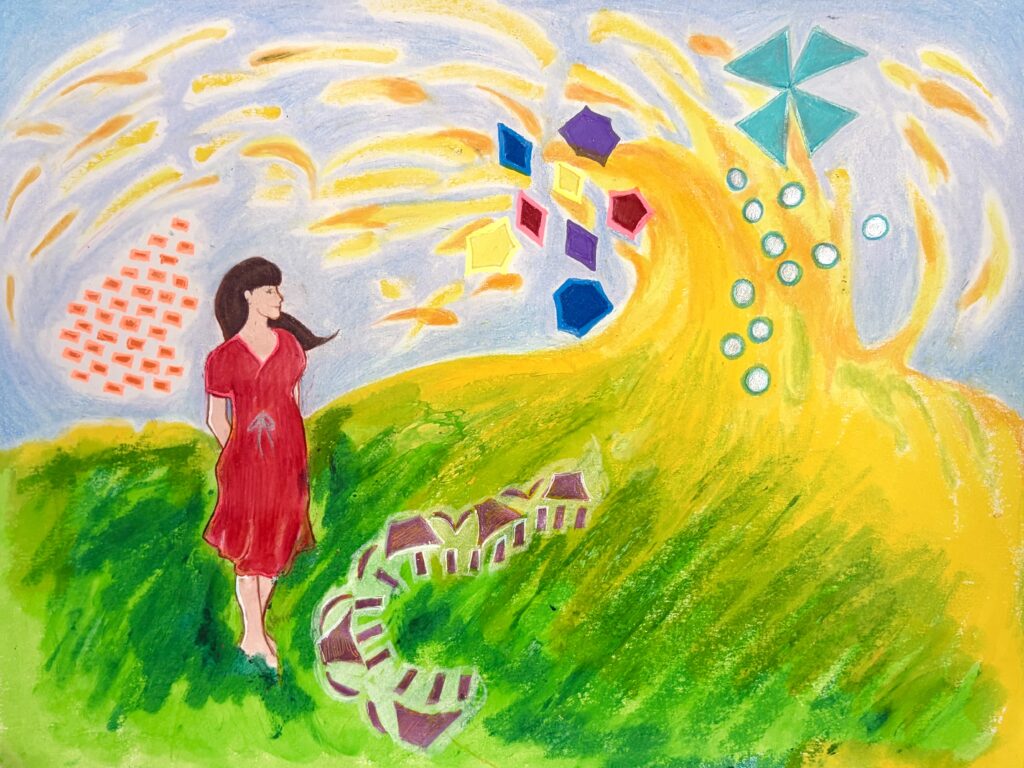
Note: The featured artwork on this post is a portrait of me in Hyrule Field (the expansive field that connects all of the regions of the world in the video game Legend of Zelda: Ocarina of Time), a meaningful virtual place I enjoy visiting from time to time. In this image, I’m looking back at shapes which are representations of elements in of the engineering/computer science exhibit discussed in this blog post. The shapes closer to me are representations of crochet stiches I’m using right now to make a few sweaters as gifts.
